Workshop / OFUTON KOBO
Our Own Workshop in Japan
Making shikibuton in our own workshop since 1962.In 1962 (Shōwa 37), OFUTON KOBO established its own workshop.
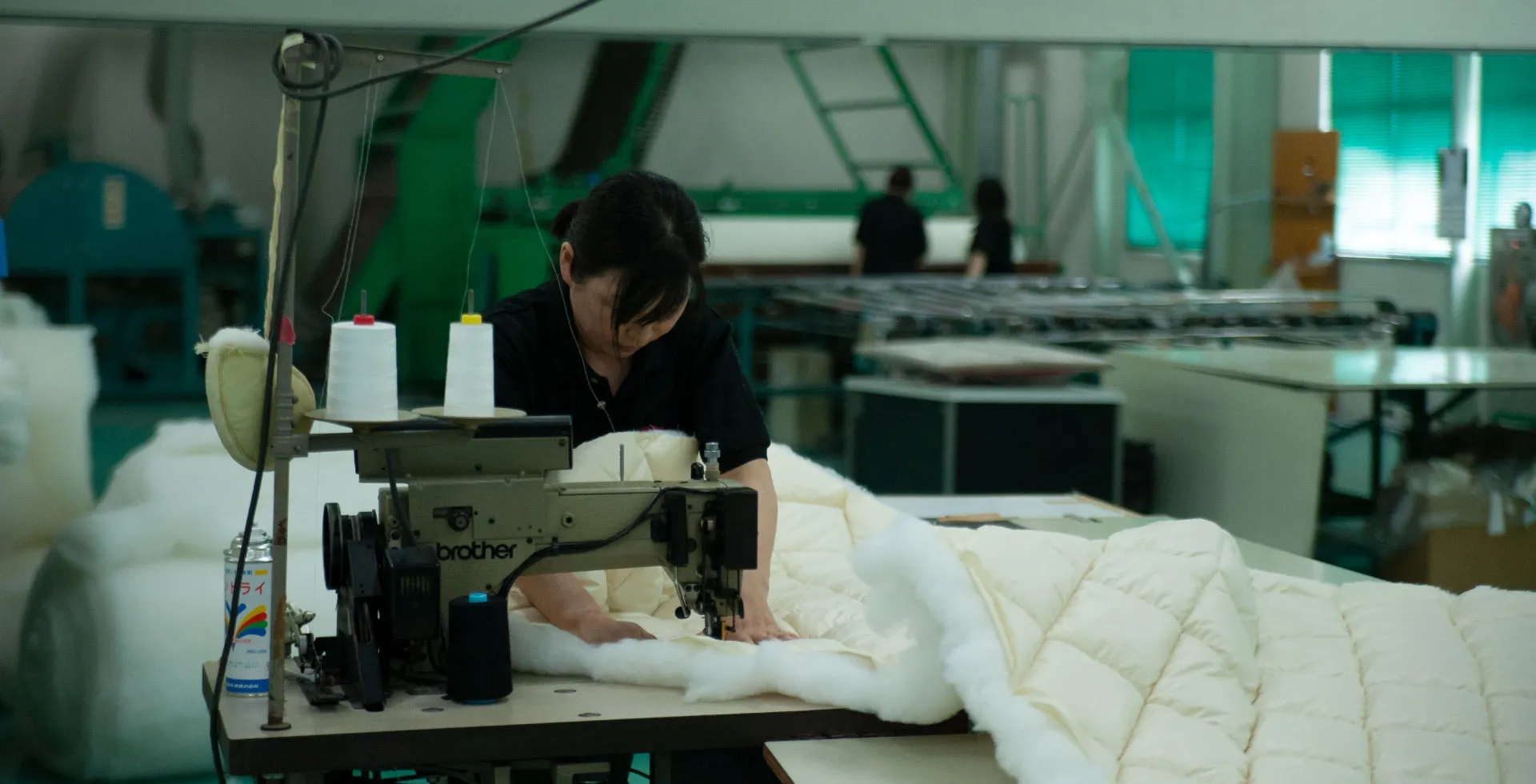
More than six decades later, the family still works directly with the materials, machinery, sewing, filling, inspection, finishing, and packing that shape each shikibuton.
The business began as the Takahashi Cotton Shop in Kōtō, Tokyo in 1873.
The scale and equipment have changed, but the principle has not: keep responsibility for the work close to the people who make it.
Inside the workshop
The work, shown as it is done.
A relay through the workshop follows the people and equipment responsible for each stage, from preparing the materials to the final inspection.
- Location
- Oyama, TochigiOur own workshop in Japan
- Established
- 1962Shōwa 37
- Today
- In operationMore than six decades of making
- Representative
- Nakajō YūsukeFifth Generation · appointed 2017
About the workshop
Why we keep our own workshop
Keeping the work in our own workshop gives one team direct responsibility for how the materials are prepared, how each layer is assembled, and how the finished shikibuton is inspected.
The people who operate the equipment can see the work before and after their own stage. Questions about materials, construction, or a customer's order can be traced back without passing through an anonymous production chain.
The workshop is also the practical foundation behind J∞QUALITY participation, futon-manufacturer certification K2600190003, and membership in the Japan Futon Manufacturers' Cooperative. The workshop process and the external certification records remain distinct, so each claim can be understood on its own terms.
- 01
In-house
Preparation, layering, sewing, filling, inspection, finishing, and packing are overseen by our workshop team.
- 02
Since 1962
The family's own workshop has remained the centre of its shikibuton making for more than six decades.
- 03
Family stewardship
Nakajō Yūsuke carries the work forward as the Fifth Generation representative.
- 04
Documented
Memberships and certification numbers are presented with their issuer and scope, rather than as unexplained badges.
Made in Japan · documented

Certification 01
J∞QUALITY member company
J∞QUALITY is a Japanese textile-industry program that communicates approved domestic production processes and production background.
Certification 02
Futon-manufacturer certification
K2600190003 is the J∞QUALITY futon-manufacturer certification number presented by OFUTON KOBO. Safety and compliance certifications by stage: K2104190001 (cotton preparation and fibre refinement), K2107190005 (sewing), K2105190002 (futon manufacturing), and K2106190004 (planning and retail).
Certification 03
Japan Futon Manufacturers' Cooperative member
The cooperative brings Japanese futon manufacturers together around industry standards, quality practice, and consumer confidence.